
Digital Light Fasting is not just about closing your eyes; it is about closing the portal to the outside world so your inner world can finally speak. In an age where electricity has colonized the night, we have forgotten that darkness is not an emptiness to be filled with screens, but a biological nutrient essential for our survival.
I recall a specific Tuesday night when the “wired but tired” feeling hit its peak. It was 11 PM. My body was heavy with exhaustion, yet my mind was racing at a thousand miles an hour. I was scrolling through a feed of beautiful images, but the light hitting my retinas felt like a silent scream. My bedroom was bathed in the artificial blue glow of the screen—a perpetual, ghostly noon. I realized then that I wasn’t just suffering from insomnia; I was suffering from light pollution of the soul.
This article is an invitation to reclaim the velvet safety of the night. It is a guide to Digital Light Fasting, the somatic practice of dimming your environment to signal to your primal brain that the day is done, the tiger is sleeping, and you are safe to rest.
Table of Contents
Table of Contents
Escaping the Perpetual Noon: Why Your Sleep is Broken
Light is not just illumination; it is information. When sunlight hits your eyes, it tells your brain “It is morning, release cortisol, be alert.” When you stare at blue light from a phone or laptop at 10 PM, you are biologically screaming at your pineal gland that it is 12:00 PM.
This creates “Circadian Chaos,” a common symptom of modern Post-AI Burnout. Your body is waiting for a sunset that never comes.
We live in a state of biological confusion. We treat darkness as an inconvenience, flipping switches to extend the day. But the nervous system cannot settle in a fake noon. By ignoring the dark, we bypass the body’s natural wind-down process, leaving us stranded on the shores of sleep, unable to drift off.
Rituals for Digital Light Fasting and Evening Peace
To heal this circadian disruption, we must ritualize the transition from day to night using slow living rituals. Here are two signature practices to anchor Digital Light Fasting in your home.
1. The Digital Sunset
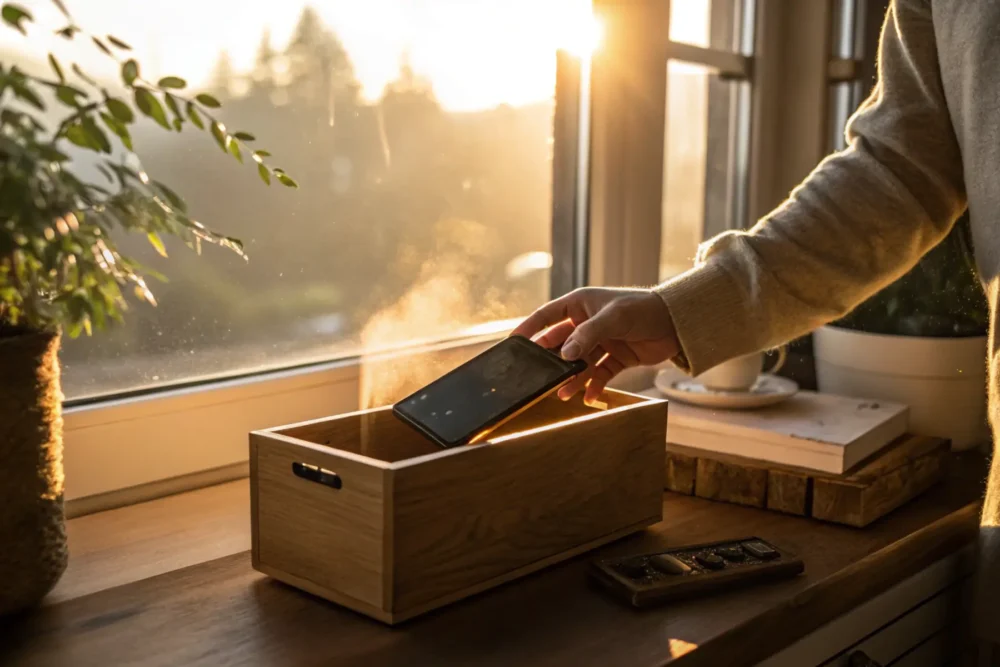
Just as the sun goes down, our devices must “set.”
- The Concept: You cannot rely on willpower to stop scrolling; you need an environmental cue to create a digital sanctuary.
- The Practice: Determine the time of the actual sunset (or pick a fixed time like 8 PM). At this minute, turn on “Red Mode” on your devices, or better yet, put them in a drawer in another room. This physical separation breaks the dopamine loop and allows your melatonin to rise naturally.
2. The Candlelight Threshold
We replace the harsh blue light with the ancestral safety of fire.
- The Concept: Firelight (and red light) does not suppress melatonin. It signals “camp” and “safety” to the primal brain.
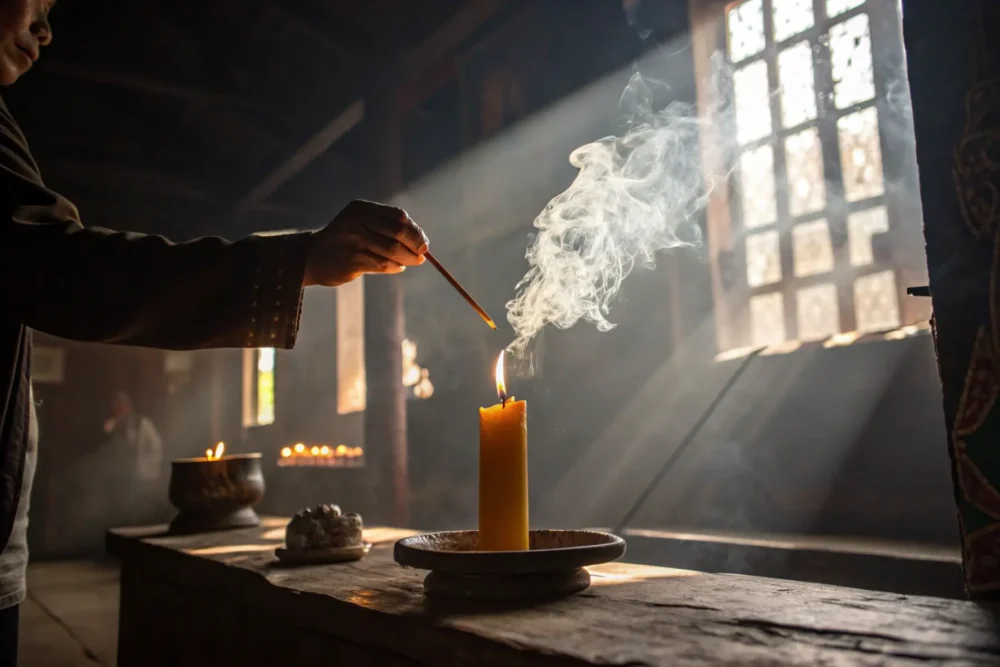
- The Practice: One hour before bed, turn off all overhead LED lights. Switch to low lamps with amber bulbs or light beeswax candles. Watch how your breathing deepens when the room is bathed in warm, flickering shadows. This is the somatic signal for rest.
The Biology of Digital Light Fasting and Melatonin
To trust this practice, we must understand the deep physiology behind Digital Light Fasting.
The pineal gland, a tiny pinecone-shaped structure in the brain, is the “third eye” that regulates sleep. It releases melatonin, the hormone of darkness, only when specific light receptors in the eyes stop detecting blue wavelengths.
As neuroscientist Dr. Andrew Huberman states:
“Viewing light at night can suppress melatonin levels (External Source) by more than 50%, and it can take hours for them to recover. Light is the primary timekeeper for the brain.”
When you practice Digital Light Fasting, you are not just “relaxing”; you are chemically permitting your body to repair itself. You are opening the gate for deep, restorative sleep cycles that clean the brain of metabolic waste.
From Wired to Velvety: The Somatic Shift
The transformation that occurs when you embrace the dark is profound. It shifts you from a state of hyper-vigilance to a state of Narrative Rest.
In the dark, you are no longer a consumer of information; you are a dreamer. You stop inputting data and start processing emotion. The anxiety of the day dissolves not because you “fixed” it, but because you allowed your nervous system to enter the safety of the night.
As sleep expert Matthew Walker, author of Why We Sleep, reminds us:
“Sleep is the single most effective thing we can do to reset our brain and body health each day.”
By protecting your darkness, you protect your sanity.
Inquiries for the Twilight Soul
Open your journal—by candlelight, if possible—and explore these gentle mindfulness exercises to deepen your relationship with the dark.
- What am I afraid I will miss if I turn off the lights and the screens?
- How does my body feel when I am bathed in blue light versus warm amber light? (Tight vs. Soft?)
- If the night were a person, how would she want to hold me right now?
📌 The Digital Sunset Manifesto: 5 Laws of Darkness
(Do not just read these laws. Embody them. Save this section to your “Sleep Rituals” board and join our visual sanctuary on PeaceScroll Pinterest for your daily calm.)
Here are the 5 Laws of the Digital Sunset, paired with a micro-ritual to signal sleep to your biology.
Law 1: The Sunset Boundary
“I honor the sun. When it rests, my devices rest.”
- ⚡ When to use it: At 8 PM or when the sun goes down.
- 🌑 The Somatic Action: Physically walk to your “charging station” (outside the bedroom) and plug in your phone. Say out loud: “The day is done.”
Law 2: The Overhead Ban
“I do not live in a supermarket. I turn off the big lights to invite the soft shadows.”
- ⚡ When to use it: The moment you finish dinner.
- 🌑 The Somatic Action: Flip the switch. Turn on a small amber lamp or light a candle. Watch the shadows lengthen and feel your shoulders drop in response.
Law 3: The Red Light Safety
“My eyes deserve peace. I protect them from the blue scream of the screen.”
- ⚡ When to use it: If you must use a screen after dark.
- 🌑 The Somatic Action: Toggle your phone/computer to “Red Tint” or “Night Shift” mode immediately. Imagine this red filter is a shield protecting your melatonin.
Law 4: The Morning Anchor
“To sleep well in the dark, I must witness the light.”
- ⚡ When to use it: Within 30 minutes of waking up, as part of your morning routine.
- 🌑 The Somatic Action: Go outside or stand by an open window. Let natural sunlight hit your face for 5 minutes. This anchors your circadian clock so you will be tired tonight.
Law 5: The Bedroom Sanctuary
“My bedroom is a cave for hibernation, not a cinema for consumption.”
- ⚡ When to use it: When you feel tempted to bring the laptop to bed.
- 🌑 The Somatic Action: Touch the doorframe of your bedroom before entering. Visualize a barrier that blocks all technology from crossing the threshold. Enter empty-handed.
A Soft Closing & An Invitation to Quietude
Digital Light Fasting is a return to your natural state. It is a declaration that your biology is more important than your feed. By curating the light you consume, you curate the quality of your rest, your mood, and your life.
If you wish to continue this journey of reclaiming your natural rhythms and finding peace in a chaotic world, I invite you to join us in the PeaceScroll Circle.
This is not a marketing list. It is a weekly Letter of Quietude & Clarity, sent from my sanctuary to yours. It is a moment of pause in your inbox, offering guidance on circadian health, somatic rituals, and slow living.
Frequently Asked Questions (FAQ)
What is Digital Light Fasting?
Digital Light Fasting is the somatic practice of eliminating artificial blue light exposure (from screens and LED bulbs) after sunset. Unlike a standard digital detox which focuses on content, this practice focuses on biology: by darkening your environment, you signal to your pineal gland that it is night, allowing for the natural production of melatonin and deeper sleep.
How is Digital Light Fasting different from a Digital Detox?
A digital detox is about mental health (breaking the dopamine loop of scrolling), while Digital Light Fasting is about circadian health (fixing your sleep clock). You can technically do a digital detox while reading a book under a bright LED light, but that light would still keep you awake. Light fasting requires dimming the environment, regardless of whether you are using a device or not.
Does red light really help with sleep?
Yes. Red light has a low color temperature and long wavelength that does not stimulate the melanopsin receptors in the eyes. This means you can use red bulbs or candlelight to see in the evening without signaling “daytime” to your brain. It is the only form of light that does not suppress melatonin production.
How long before bed should I start Digital Light Fasting?
Ideally, you should initiate your “Digital Sunset” 1 to 2 hours before sleep. Research suggests that even short bursts of bright blue light can delay melatonin release by up to 90 minutes. Creating a buffer zone of amber light or darkness gives your nervous system enough time to transition from “alert mode” to “rest mode.”