
The dark feminine aesthetic is often misunderstood as a mere trend of lace, eyeliner, and moody playlists. But for those of us who walk the path of deep internal work, we know it is something far more visceral. It is an external signal of an internal revolution—a visual language for the woman who has stopped asking for permission to exist in her fullness.
I remember the distinct moment this shift took root in my own spirit. It wasn’t at a party or a ritual, but on a Tuesday evening, alone. The rain was drumming a relentless, chaotic rhythm against my windowpane. I lit a single candle—scent of smoked oud and earth—and wrapped myself in a heavy, charcoal-colored throw. As I ran my hand over the rough texture of my journal, I felt a sudden, fierce clarity. I was done being “pleasant.” I was done shrinking to make others comfortable. In that quiet shadow, surrounded by the dark comfort of the room, I didn’t feel fear; I felt held. I felt powerful.
This is the true essence of the dark feminine aesthetic: it is not about dressing to impress the gaze of others, but dressing to honor the depth of your own soul. It is the “War Paint” we wear as we undertake the sacred work of integrating our shadows.
The Shadow and the Silk: Why We Need This Aesthetic Now
In a world that demands constant brightness, toxic positivity, and performative happiness, the dark feminine aesthetic offers a necessary sanctuary of truth. It is the visual counter-weight to the “Good Girl” conditioning that many of us have carried for decades.
Psychologist Carl Jung famously said, “One does not become enlightened by imagining figures of light, but by making the darkness conscious.”
This aesthetic is the practice of making that darkness conscious. It is about inviting the parts of yourself you were told to hide—your anger, your boundaries, your mystery, your wildness—to sit at the table. By surrounding ourselves with deeper tones, richer textures, and symbols of mystery, we signal to our nervous system that it is safe to be complex.
Main Rituals: Anchoring the Aesthetic in Reality
To embody this energy, we must move beyond Pinterest boards and into tangible practice. Here is how to weave the dark feminine aesthetic into your daily rhythm, not as a costume, but as a practice of self-reverence.
1. The “Obsidian Mirror” Morning Rite
Instead of rushing to the mirror to critique your flaws, practice this PeaceScroll signature concept.
The Obsidian Mirror Rite: This is the act of dressing with the intention of protection rather than attraction. Choose one item—a black tourmaline ring, a velvet blazer, a scent with notes of amber—and designate it as your “shield.” As you put it on, visualize it sealing your energy field. You are not dressing for the world; you are dressing for yourself.
2. Sensory Architecture of the Night
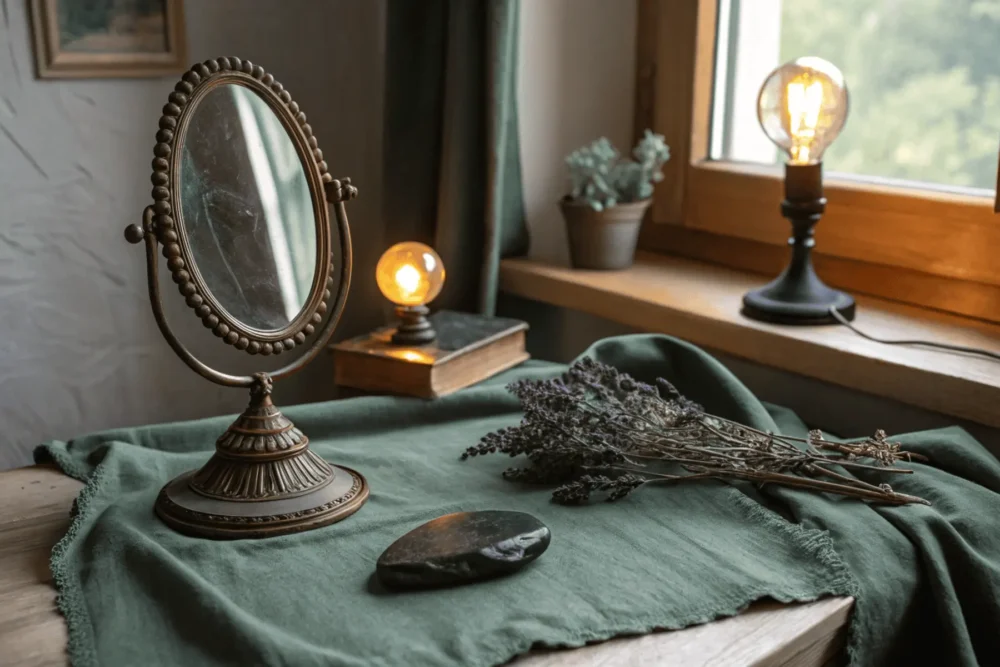
Curate your space to reflect the depth you seek. The dark feminine aesthetic thrives on low sensory input to calm the nervous system.
- Lighting: Never overhead. Use amber-hued lamps or beeswax candles to mimic the safety of a cave or womb space.
- Texture: Replace synthetic fabrics with heavy, grounding materials. Think linen, velvet, or wool—textures that demand to be felt.
Beyond the Visuals: The Psychology of the Dark Feminine Aesthetic
The visual cues are powerful, but they are hollow without the psychological framework. The dark feminine aesthetic is, at its core, a form of somatic therapy.
Magnetic Sovereignty is the state of being grounded in one’s own authority, requiring no validation from the outside world. It is the shift from chasing approval to attracting what aligns with you through the power of your own presence.
When you adopt this aesthetic, you are essentially engaging in Shadow Work. You are externalizing the “Shadow Self”—the parts of you that are messy, emotional, and fierce. By wearing the dark lip or the structured coat, you are physically validating these internal parts. You are telling your subconscious: “I see you. I honor you. You are allowed to be seen.”
Channeling the Archetypes: Lilith and The High Priestess
To fully understand the dark feminine aesthetic, we look to the archetypes that govern it. These are not characters to worship, but psychological blueprints to study.
- The High Priestess: She represents intuition and the subconscious. She does not shout; she knows. Embracing this aesthetic is an invitation to trust your gut over societal logic.
- Lilith: Often vilified, Lilith represents the woman who refuses to be subservient. She is the raw boundary. She is the energy that says “No” without explanation.
Integrating these archetypes allows us to move through the world with a mysterious, calm power. We stop over-explaining. We stop apologizing for taking up space.
As the Jungian analyst and author Clarissa Pinkola Estés wrote in Women Who Run With the Wolves:
“The wild nature has a vast integrity to it… It establishes territory, finds one’s pack, resides in one’s own body with certainty and pride.”
This aesthetic is simply the visual claiming of that territory.
War Paint for the Soul: Using Aesthetics to Fortify Boundaries

How does a piece of clothing or a lipstick shade help you hold a boundary? By acting as a “state change” trigger for your brain.
We use what I call The Velvet Fortress Protocol.
The Velvet Fortress Protocol is a visualization technique used in conjunction with the dark feminine aesthetic. When you wear your chosen “power piece” (e.g., a dark trench coat), imagine it as a physical boundary. Anything that drains you—unsolicited advice, negativity, energy vampires—hits the fabric and slides off. You remain soft on the inside, but protected on the outside.
Remember the words of the poet Audre Lorde, who understood the power of reclaiming one’s voice:
“Your silence will not protect you.”
The dark feminine aesthetic is the decision to stop being silent and to let your presence speak before you even utter a word.
Journaling Prompts for the Shadow Self
Open your journal—perhaps one with thick, unlined paper—and explore these questions to deepen your connection to the dark feminine aesthetic and your own power.
- If I stopped trying to be “good” and “pleasant,” who would I be? What does she look like?
- What part of my power have I been afraid to show because I thought it was “too much” or “too dark”?
- How does the silence of the night make me feel? Do I find comfort in the shadows, or do I run from them?
📌 Pin-Worthy Rituals: The Dark Feminine Manifesto
(Do not just read these laws. Embody them. Save this section to your “Shadow Work” board and join our visual sanctuary on PeaceScroll Pinterest.)
Here are the 5 Laws of Magnetic Sovereignty, paired with a micro-ritual to anchor them into your body.
Law 1: The Anchor of Stillness
“I do not chase. I deepen my roots, and what belongs to me finds me.”
- ⚡ When to use it: When you feel anxious about a text back, a job offer, or someone leaving your life.
- 🌑 The Somatic Action: Stop moving physically. Plant both feet firmly on the floor. Exhale longer than you inhale. Visualize your energy sinking into the earth like dark roots. Feel the gravity holding you.
Law 2: The Shield of Silence
“My ‘No’ is a complete sentence. It is a sacred protection of my energy.”
- ⚡ When to use it: When asked for a favor you don’t want to do, or when someone demands an explanation you don’t owe.
- 🌑 The Somatic Action: Maintain eye contact but relax your jaw. Do not smile simply to be polite. Keep your face neutral (the “Dark Feminine Gaze”). Say “No” or “That won’t work for me,” then embrace the silence that follows without rushing to fill it.
Law 3: The Altar of Shadows
“I honor my shadows. My anger, my grief, and my wildness are welcome here.”
- ⚡ When to use it: When you feel “too much,” “too emotional,” or are judging yourself for not being positive.
- 🌑 The Somatic Action: Place a hand on your solar plexus (stomach) or heart. Close your eyes. Instead of pushing the emotion away, invite it in like a guest for tea. Whisper: “I see you, and you are safe here.”
Law 4: The Aesthetic of Soul
“I dress for my soul. My aesthetic is a reflection of my internal depth, not a performance for others.”
- ⚡ When to use it: While getting dressed in the morning or applying makeup.
- 🌑 The Somatic Action: As you apply your lipstick or put on your coat, visualize it as War Paint or Armor. Look in the mirror and ask: “Does this make me feel seen by the world, or seen by myself?” Choose the latter.
Law 5: The Veil of Mystery
“I am the mystery. I am under no obligation to explain myself to anyone who does not understand my language.”
- ⚡ When to use it: In social situations where you feel misunderstood or judged.
- 🌑 The Somatic Action: Visualize a velvet cloak wrapped around your shoulders. Imagine this cloak absorbs their judgments so they never touch your skin. Offer a small, mysterious smile, and keep your truths for those who have earned the right to hear them.
A Soft Closing & An Invitation to Quietude
The dark feminine aesthetic is a journey, not a destination. It is the slow, deliberate process of coming home to the parts of yourself you left behind in the dark. It is realizing that the dark was never scary—it was just waiting for you to return and claim your power.
If you wish to continue this journey of reclaiming your depth and finding peace in a chaotic world, I invite you to join us in the PeaceScroll Circle.
This is not a marketing list. It is a weekly Letter of Quietude & Clarity, sent from my sanctuary to yours. It is a moment of pause in your inbox, offering guidance on shadow work, nervous system regulation, and slow living.
[Receive the Letter of Quietude]
Frequently Asked Questions (FAQ)
1. What is the true meaning of the Dark Feminine Aesthetic?
The dark feminine aesthetic is not just a visual style; it is the external expression of Shadow Work. While it uses dark colors, lace, and moody imagery, its true purpose is to symbolize Magnetic Sovereignty—the state of reclaiming one’s power, boundaries, and mystery. Unlike “Light Feminine” energy which focuses on nurturing and openness, the dark feminine focuses on transformation, authenticity, and the protection of one’s energy.
2. Is Dark Feminine Energy considered “evil” or negative?
No. In psychology and spirituality, the term “dark” refers to the subconscious mind and the Shadow Self (a concept by Carl Jung), not to evil or malice. Embodying the dark feminine aesthetic is about making the darkness conscious—acknowledging your anger, desires, and raw power instead of repressing them. It is a healing journey toward wholeness, not a celebration of negativity.
3. How is the Dark Feminine Aesthetic different from Goth or Whimsigoth?
While they share visual elements (black clothing, velvet, mystery), the distinction lies in the intent.
Goth is a subculture deeply rooted in music (post-punk, dark wave) and specific historical influences.[1]
Dark Feminine is a psychological and spiritual archetype focused on empowerment and seduction of the self.[2] You can dress in a dark feminine way without being part of the goth subculture; it is more about “War Paint for the Soul” than musical affiliation.
4. Can I embody the Dark Feminine if I have a “soft” personality?
Absolutely. The dark feminine aesthetic is not about changing who you are, but about integrating boundaries into your softness.[3][4] You can use the aesthetic as a tool—like the Velvet Fortress Protocol—to signal to the world (and yourself) that your softness is protected. Many women use this aesthetic to transition from people-pleasing (“Fawn response”) to a more grounded, confident version of themselves, without losing their compassionate heart.