
I remember the exact moment the concept landed in my body, not just my mind. It was a Tuesday afternoon, heavy with the grey mood of Post-AI Burnout. I was walking to my car, my shoulders tight, my jaw clenched—a walking armor of stress. Suddenly, the sunlight hit a puddle of oil and water on the asphalt, creating a swirling, iridescent rainbow. I stopped. For three seconds, the world went quiet. My breath dropped into my belly. The tightness in my chest unspooled.
That tiny, fleeting flash of beauty didn’t solve my problems, but it reminded my biology that safety still existed.
This is the essence of glimmers. They are not grand gestures of happiness; they are the somatic sparks that remind us we are alive. This article is a sanctuary for your tired nervous system. It is a reclamation of your ability to see the light, even when the world feels overwhelmingly dark.
Table of Contents
Table of Contents
🏆 What is Glimmers?
Glimmers are small, fleeting moments that spark a sense of safety, connection, and regulation within the nervous system. Coined by licensed clinical social worker Deb Dana within the context of Polyvagal Theory, they are the biological opposite of “triggers.” While triggers activate the sympathetic nervous system (fight or flight), glimmers activate the ventral vagal system (rest and digest), signaling to the brain that it is safe to relax and connect.
The Biology of Safety: Why We Scan for Danger
To understand why we need glimmers, we must understand why we naturally ignore them. Our brains are hardwired with a “negativity bias.” To keep our ancestors alive, the brain evolved to scan for tigers (danger), not rainbows (safety).
We are biologically programmed to overlook the good to survive the bad.
However, in our modern world, this survival mechanism often leaves us stuck in chronic hyper-vigilance. We scan for rejection, failure, and stress. Glimmers are the antidote. They are not about “toxic positivity” or ignoring pain; they are about retraining the Reticular Activating System (RAS) in your brain to notice that safety and beauty are co-existing with the chaos.
🌿 Somatic Rituals to Harvest Glimmers Daily
We cannot force a glimmer, but we can prepare the soil to receive one. Here are two signature somatic exercises to begin your practice of collecting light.
1. The 5-Second Savor
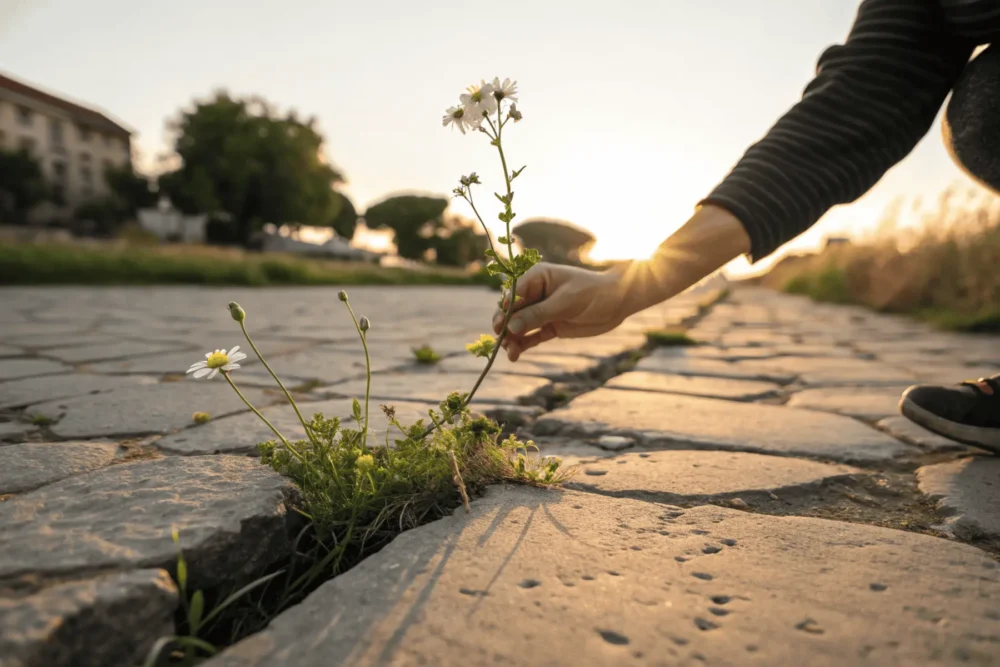
The nervous system needs time to register safety. A glance is not enough; you must linger.
- The Concept: “Velcro for the good, Teflon for the bad.” (Rick Hanson).
- The Practice: When you notice a tiny spark—the smell of coffee, the texture of a blanket, a kind smile—do not look away immediately. Stop for 5 full seconds. Breathe it in. Let the sensation physically land in your chest. This turns a fleeting moment into a lasting divine healing ritual.
2. The Glimmer Map
We often look for glimmers in the wrong places. We must identify our personal sources of safety.
- The Concept: Create a visual or mental map of where your biology feels most at home.
- The Practice: Dedicate one page in your journal to “Glimmer Hunting.” List 3 sounds, 3 sights, and 3 textures that historically calm you. When you feel dysregulated, consult your map. Do not wait for the glimmer to find you; go to where the glimmers live.

🧠 How Glimmers Reshape Your Nervous System
To truly trust this practice, we must dive deeper into the science. Glimmers are not magic; they are mechanics.
According to Polyvagal Theory, our nervous system moves between states: Dorsal (shutdown), Sympathetic (mobilization), and Ventral Vagal (safety). Triggers push us down the ladder into survival. Glimmers gently pull us up the ladder into connection.
Every time you acknowledge a glimmer, you are “toning” your Vagus Nerve. You are widening your window of tolerance. You are teaching your body that it is safe to come out of armor and into the world.
The Glimmer Scavenger Hunt: A Sensory Menu
Sometimes, the world feels too heavy to find the light, and your mind draws a blank. When that happens, use this Sensory Menu. Think of it as a checklist for your soul—proof that safety exists in small, tangible forms. These are simple gentle mindfulness exercises you can do anywhere.
Scan your environment for just one of these right now:
- 👁️ Sight (Visual Anchors):
- The way sunlight hits a glass of water (refraction).
- A flower growing through a crack in the concrete (resilience).
- The specific “golden hour” light just before sunset.
- A stranger’s genuine smile or a dog wagging its tail.
- 👂 Sound (Auditory Anchors):
- The sound of rain against the windowpane.
- The hum of a coffee machine brewing.
- Birdsong in the early morning.
- The silence of a house when everyone else is asleep.
- ✋ Touch (Tactile Anchors):
- The shock of cold water on your face.
- The weight of a heavy blanket.
- Petting an animal’s soft fur.
- Clean sheets against bare skin.
- 👃 Smell (Olfactory Anchors):
- The scent of old books or a library.
- Petrichor (the smell of earth after rain).
- Peeling a fresh orange.
- Your favorite person’s hoodie.
From Armor to Softness: The Transformation
The shift is subtle but profound. You stop waiting for the “big break” or the vacation to feel at peace. You begin to resource yourself in the micro-moments of the Now.
As Deb Dana, the creator of the concept, states:
“Glimmers are not just tiny moments of joy. They are cues of safety that reshape our system.”
By collecting these sparks, we build a bonfire of resilience. We become capable of holding the darkness because we know where to find the light.
✍️ Collecting Light: Inquiries for the Nervous System
Open your journal—feel the weight of the pen, the texture of the page—and use these prompts, much like shadow work journal prompts, to sharpen your vision for safety.
- What is the last thing I saw that made my shoulders drop instinctively?
- If safety had a texture (like velvet, moss, or warm water), what would it feel like to me?
- What is a sound I often ignore that actually brings me peace? (Birdsong, the hum of the fridge, rain).
📌 The Glimmer Manifesto: 5 Laws of Safety
(Do not just read these laws. Embody them. Save this section to your “Nervous System” board and join our visual sanctuary on PeaceScroll Pinterest for your daily calm.)
Here are the 5 Laws of Glimmers, paired with a somatic trigger to anchor them.
Law 1: The Micro-Pause
“I do not rush past beauty. I stop to honor the spark.”
- ⚡ When to use it: When you see a beam of sunlight or a flower during your morning routine.
- 🌑 The Somatic Action: Stop walking. Take one deep inhale through the nose. Let the image imprint on your mind before moving again.
Law 2: The Biological Yes
“I trust my body’s ‘Yes.’ If it feels expansive, it is for me.”
- ⚡ When to use it: When you feel a sudden, unexplained lightness or warmth.
- 🌑 The Somatic Action: Place a hand on your heart. Say “Thank you.” Acknowledge the safety signals.
Law 3: The Abundance of Light
“Safety is not scarce. It is waiting for me to notice it.”
- ⚡ When to use it: When you feel overwhelmed by the news or negativity.
- 🌑 The Somatic Action: Look around the room. Find one object that is your favorite color. Focus on it until your breath slows.
Law 4: The Shared Spark
“A glimmer shared is a glimmer doubled. I connect through joy.”
- ⚡ When to use it: When you see something lovely and have the urge to keep it to yourself.
- 🌑 The Somatic Action: Send a photo or text to a friend immediately: “This made me think of you.” Feel the connection strengthen.
Law 5: The Gentle Return
“I use glimmers to return home to myself.”
- ⚡ When to use it: After a stressful meeting or a trigger.
- 🌑 The Somatic Action: Rub your palms together to create heat. Place them over your eyes. Visualize the last glimmer you saw. Reset. This is a foundational act in the art of self-love.
🌙 Soft Closing & The Sanctuary Invitation
Glimmers are the breadcrumbs that lead us back to ourselves. They are the quiet words of wisdom from the world saying, “You are safe here.” By attuning our eyes to see them, we do not ignore the pain of the world; we simply ensure we have the strength to face it.
If you wish to continue this journey of somatic healing and finding the light in the cracks, I invite you to join us in the PeaceScroll Circle.
This is not a marketing list. It is a weekly Letter of Quietude & Clarity, sent from my sanctuary to yours. It is a moment of pause in your inbox, offering guidance on nervous system regulation, somatic rituals, and slow living.
Frequently Asked Questions (FAQ)
What is the psychological definition of a glimmer?
In psychology, specifically within the framework of Polyvagal Theory developed by Deb Dana, glimmers are micro-moments of safety and connection. unlike grand joyous events, glimmers are tiny, everyday cues (like the smell of coffee or a kind smile) that activate the ventral vagal system, signaling to your nervous system that you are safe and can relax into the present moment.
What is the difference between a glimmer and a trigger?
Triggers and glimmers are biological opposites. A trigger is a cue that signals danger, pushing the nervous system into a sympathetic state (Fight or Flight). A glimmer is a cue that signals safety, moving the system into a parasympathetic state (Rest and Digest). While triggers activate survival mechanisms, glimmers build resilience and expand your “window of tolerance” for stress.
How can glimmers help with trauma and anxiety?
Trauma often leaves the nervous system stuck in a state of chronic defense (hyper-vigilance). actively hunting for glimmers helps reshape the nervous system by creating new neural pathways oriented toward safety. Over time, acknowledging these small sparks can lower baseline anxiety levels and help individuals shift out of “survival mode” more easily.
What are some common examples of glimmers?
Glimmers are unique to each nervous system, but common examples include:
Visual: Seeing a rainbow, sunlight filtering through trees (komorebi), or a dog wagging its tail.
Auditory: The sound of rain, birds singing, or a favorite song.
Sensory: The warmth of a mug, the texture of a soft blanket, or the smell of old books.
Relational: A feeling of being heard by a friend or a shared laugh with a stranger.