Post-AI Burnout is a silent epidemic. It is not the exhaustion of doing too much physical labor; it is the spiritual and somatic exhaustion resulting from living at “machine speed.” It is the subtle, humming dissonance between our silicon tools (which optimize for instant efficiency) and our carbon bodies (which optimize for cyclic rest). It is the unique grief of feeling “disembodied”—having outsourced too much of our creativity, memory, and intuition to algorithms.
I noticed the shift in myself on a quiet Thursday. I sat before my screen, the cursor blinking against the glow of an AI interface. I had generated a week’s worth of ideas in seconds. It was efficient. It was perfect. And yet, I felt completely hollow. My chest felt tight—not with stress, but with a strange numbness. I touched the smooth, cold glass of the screen and realized I hadn’t touched anything real—dirt, dough, paper, skin—all day.
I realized then that convenience has a cost. The price of frictionless living is our connection to the physical world. This article is a permission slip to be inefficient. It is a guide to recovering your “Human Spark” and finding narrative rest in a synthetic world.
The Hollow Hum: Why Your Soul is Tired of Efficiency
Think of AI like processed food for your brain. It is fast, cheap, and instantly gratifying. But just as a diet of only processed sugar leaves your body sick, a diet of only AI-generated frictionlessness leaves your spirit sick.
We are biological beings living in a digital architecture. Living at “machine speed” creates a state of chronic dysregulation. We become “Optimization Addicts,” fearful that any moment spent not producing is a waste.
As the philosopher Byung-Chul Han writes in The Burnout Society:
“Hyper-attention, which creates a frantic unrest, is not a sign of progress… Deep boredom is the peak of mental relaxation.”
We have lost that deep boredom. As we streamline our lives, we accidentally streamline our souls, creating a nervous system that is constantly stimulated by information but starved of true experience.
Somatic Rituals to Heal Post-AI Burnout
To heal from this digital fatigue, a simple “detox” is not enough. We must actively re-introduce resistance into our lives. We must embrace The Friction Ritual.
The Friction Ritual

AI creates a frictionless existence (instant answers, instant art). The nervous system creates reality through friction (sensory feedback).
- The Concept: The Friction Ritual is the intentional practice of doing a task the “hard way” to ground the nervous system.
- The Practice: Choose one task today to perform inefficiently. Write a morning routine list by hand instead of an app. Knead bread dough for 15 minutes instead of buying a loaf. Walk to a location without using GPS, allowing yourself to get slightly lost.
- The Result: This resistance signals to your brain that you are a physical entity, not just a data processor. It returns the blood to your hands and the awareness to your environment.
Cognitive Re-Wilding: Reversing Post-AI Burnout Symptoms
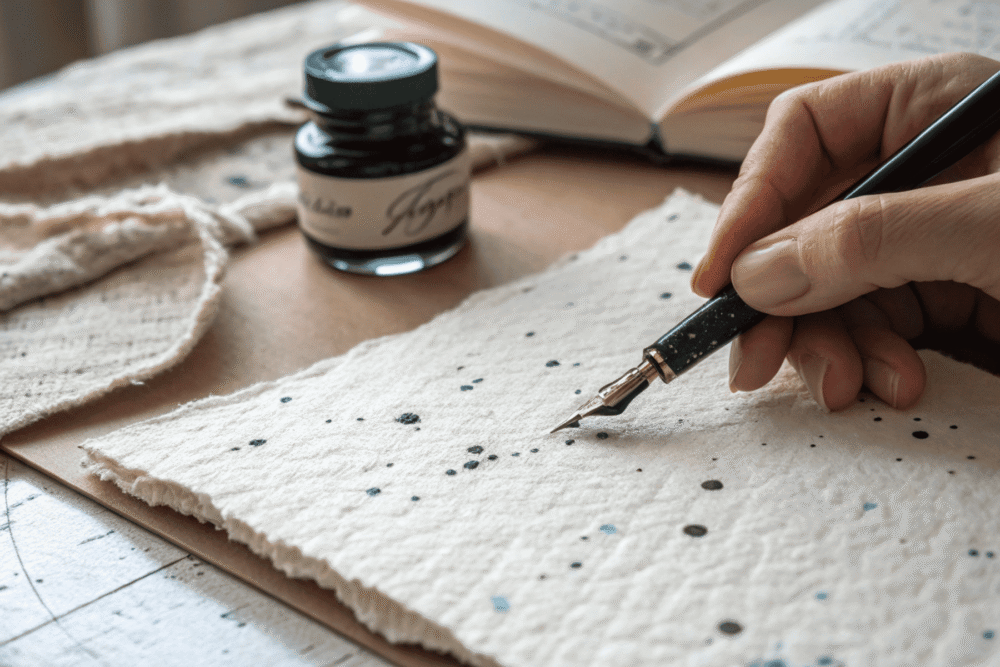
If you feel you cannot think without a prompt, you are suffering from cognitive atrophy. We counter this with Cognitive Re-Wilding.
- The Remedy: This is the act of letting your mind wander without a destination. Sit for 20 minutes with a blank page. Write down whatever comes up—nonsense, fragments, bad poetry.
- The Shift: You are repairing the neural pathways of imagination that have been weakened by auto-complete. You are remembering that your “glitches” are actually your Higher Self trying to speak.
As the legendary producer Rick Rubin reminds us in The Creative Act:
“The objective is not to learn to mimic greatness, but to calibrate our internal meter for greatness.”
No machine can calibrate your internal meter. Only silence can do that.
From Processor to Creator: The Analog Shift
AI operates on logic and probability. Humans operate on intuition and somatic resonance. Over-reliance on the “Digital Brain” silences the “Gut Brain.”
Before you ask an AI for an answer (e.g., “What should I eat?”, “How should I reply?”), perform a Somatic Check. Place a hand on your stomach. What does your gut say? Re-learning to trust your biological data over digital data is the essence of divine healing.
Excavating the Analog Soul
Open your journal—feel the grain of the paper, the drag of the ink—and explore these questions to excavate your humanity.
- Where have I traded my own voice for the convenience of an algorithm?
- How does my body feel when I spend hours in “frictionless” digital spaces? (Numb, floating, tight?)
- What is one messy, inefficient, purely human thing I love doing that has no “output” or “value”?
📌 The Analog Manifesto: 5 Laws of the Human Spark
(Do not just read these laws. Embody them. Save this section to your “Digital Wellness” board and join our visual sanctuary on PeaceScroll Pinterest for daily grounding reminders.)
Here are the 5 Laws of the Human Spark, paired with a micro-ritual to reconnect you to reality.
Law 1: The Processor Check
“I am not a processor. I am a living, breathing being who requires rest, not just a reboot.”
- ⚡ When to use it: When you feel “robotic” or catch yourself staring blankly at a screen.
- 🌑 The Somatic Action: Shake your hands vigorously for 10 seconds. Feel the blood rushing to your fingertips. Remind yourself: “I am made of blood and bone, not code.”
Law 2: The Medicine of Slowness
“Inefficiency is medicine. I embrace the slow, the messy, and the manual.”
- ⚡ When to use it: When you get frustrated because something is taking “too long.”
- 🌑 The Somatic Action: Deliberately slow your breathing down. Take one task (like making coffee) and do it in slow motion, focusing entirely on the smell and texture.
Law 3: The Glitch Gift
“My glitch is my gift. My errors and emotions make me human; perfection is for machines.”
- ⚡ When to use it: When you make a mistake and your inner critic attacks you for not being “perfect.”
- 🌑 The Somatic Action: Place a hand on your heart. Smile slightly. Say: “This mistake proves I am alive.”
Law 4: The Gut Trust
“I trust my gut over the grid. My intuition knows things the algorithm cannot predict.”
- ⚡ When to use it: Before asking ChatGPT or Google for advice on a personal decision.
- 🌑 The Somatic Action: Close your eyes. Drop your awareness from your head to your belly. Ask the question internally and wait for a feeling, not a word.
Law 5: The Friction Choice
“I create friction. I choose the pen over the keyboard, the map over the app, the earth over the cloud.”
- ⚡ When to use it: When you have the choice between an easy digital shortcut and a manual method.
- 🌑 The Somatic Action: Choose the manual way once a day. Feel the resistance of the pen on paper or the ground under your feet. Let the friction ground you.
A Soft Closing & An Invitation to Quietude
Healing from Post-AI Burnout is an act of rebellion. It is a refusal to be flattened into data. It is the brave decision to be slow, textured, and delightfully imperfect in a world that demands high-speed gloss.
If you wish to continue this journey of reclaiming your soul from the machine, I invite you to join us in the PeaceScroll Circle.
This is not a marketing list. It is a weekly Letter of Quietude & Clarity, sent from my sanctuary to yours. It is a moment of pause in your inbox, offering guidance on digital wellness, somatic rituals, and slow living.
Frequently Asked Questions (FAQ)
What are the main symptoms of Post-AI Burnout?
Unlike physical exhaustion, Post-AI Burnout manifests as a deep sense of “hollowness” or emotional numbness. Key symptoms include cognitive atrophy (feeling unable to think or write without a prompt), a loss of creative confidence, and somatic disconnection (feeling like a “floating head” with no body). It is the fatigue of under-stimulation rather than over-exertion.
How is Post-AI Burnout different from traditional burnout?
Traditional burnout is typically caused by high friction (too much work, too much stress, too much effort). Post-AI Burnout is caused by zero friction. It is a dysregulation of the nervous system resulting from a lack of resistance, causing the brain to crave the tactile, messy reality of being human.
Does using AI damage your natural creativity?
It can lead to “Creative Atrophy” if used as a replacement rather than a tool. When we outsource the messy process of brainstorming and drafting to algorithms, we weaken our neural pathways for imagination. However, you can reverse this through Cognitive Re-Wilding practices like handwriting and analog boredom.
What is the best way to recover from digital fatigue?
The most effective cure is not just a detox, but the re-introduction of “Friction Rituals.” Engage in inefficient, manual tasks that require physical effort and sensory feedback—like kneading dough, gardening, or writing with a fountain pen—to signal to your nervous system that you are alive and embodied.